

Giving Thanks for Independence of American Individuals and Communities
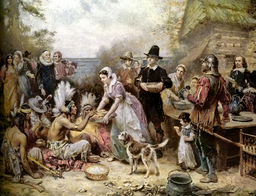
This Thanksgiving is a good time to give thanks for American independence. Not our national independence from Great Britain; that’s for the 4th of July and 2026 (the 250th anniversary year of the Declaration of Independence). I mean independence for individuals and communities. We owe a lot to the Pilgrims for helping set the course of Americans’ sense of independence more than 150 years before the Declaration of Independence.
While the reasons for establishing an earlier American colony, Jamestown, were primarily profit-seeking, the reasons the Pilgrims’ founded Plymouth Colony were mixed in a way that more broadly reflects Americans’ idea of independence. The Pilgrims’ colony was in part a capitalist venture. But the primary motivation and purpose was for the Pilgrims to be able to practice their faith and live their lives the way they wanted to, free from government and societal suppression.
The Pilgrims’ legacy is a dual one – religious/social freedom and economic independence. Like many Americans after them, the independence the Pilgrims desired was not on a purely individual basis. They had an independent spirit, but were not seeking to live in separately from others based only on self-reliance. Community was essential to them. The Pilgrims moved to America as a community, for the purpose of better maintaining their community and its values. They wanted community, but not communism. The Pilgrims chose to reject communally shared ownership of the means of production and output after they tried it and it failed miserably. Subsequent generations of Americans have followed their lead in wanting a balance of individual economic security based on private property and a cooperative community with shared religious and social values.
Religious/social freedom
The Pilgrims contributed to religious and social freedom by setting a precedent of individuals and communities moving to America in order to live their lives and practice their faiths how they want. The Pilgrims’ journey from England to America was prompted by conflict with the government-established Church of England. The Pilgrims were an offshoot of the “Puritan” movement that wanted to reform the Church of England to return to a simpler faith and less structured forms of worship, similar to the early Christians. The Pilgrims were part of a more radical group that believed the Church of England was beyond reform. Called “Separatists,” they wanted to form new church congregations separate from the Church of England. This was dangerous. In 1600s England, it was illegal to be part of any church other than the Church of England. Some of the Pilgrims in England were harassed, fined, or jailed. To escape persecution, the Pilgrims first went to the Netherlands (Holland). They were allowed to practice their own religion there. But they were not fully in control of their own destiny as a community. Some older children were tempted by the Dutch culture and left their families. The Pilgrims feared they would lose their identity as English people. They also worried that another war might break out between the Dutch and Spanish. They therefore decided to establish their own colony in America where they could form a community to live their lives and practice their faith the way they wanted. For more details, see here.
The Pilgrims’ contribution to religious and social freedom was limited. They (and the Puritans who founded the nearly Massachusetts Bay Colony) were not open to everyone freely choosing how to practice their own religion. Although they bristled at others telling them what to do, they sought to control the people within their own communities. They were not practicing the “golden rule” not to do to others what you don’t want them to do to you. But while they were largely successful at exercising control over their communities, they could not prevent Americans from developing their own ideas of how to worship and live their lives, nor prevent them from doing so by moving out of the community. Thankfully for Americans’ spirit of independence, many of those who left to form their own communities chose to follow the golden rule. They realized that just as they wanted religious and social freedom, they needed to allow others the same right. Live and let live. That tradition did not take long to start. For example, as early as 1636, Roger Williams fled persecution in Massachusetts and founded Providence on land he bought from the Narragansett. Williams experimented with ideas of religious equality, civil participation, democracy, free speech, and personal liberty. He established a policy of religious and political freedom in his new settlement. As a result, other leaders advocating freedom of worship soon established similar communities on either side of Narragansett Bay. Over the following centuries, America has had a long tradition of individuals and groups forming their own communities to live their lives and faith the way they want. Some examples are William Penn (Quaker Pennsylvania and the promise of religious freedom), Amish and Mennonites, Mormons, monastic Christian communities such as Augustinian friars, and the efforts at small-scale, secular rural communal living that peaked in the 1960s and 70s, among others. Although the Pilgrims did not practice religious and social tolerance themselves, they started a process of making America a land of religious and social freedom where the American sense of independence is to be able to live your life and faith as you want, either on an individual or community basis.
Economic independence
The Pilgrims also helped start the American ideal of economic independence. Most Americans (starting with the Pilgrims) want to more directly control their own individual destinies through private property and freedom of economic relations. Americans have always tended to have a spirit of independence, which has resulted in (and been the result of) widespread individual ownership of private houses, farms, and small businesses. This American ideal of economic independence through ownership of private property was learned at least in part from the Pilgrims’ difficult experience with, and rejection of, communalism.
The Pilgrims learned the subpar results of communalism the hard way in the first three years after they established their colony at Plymouth, Massachusetts in 1620. The Pilgrims faced starvation during their first year of arrival, but survived due to the Wampanoag tribe sharing food and their knowledge about local hunting and planting. By 1621, the Pilgrims were doing well enough to have the famous harvest celebration with the Wampanoag that we celebrate as the first Thanksgiving. However, in the following two years, the Pilgrims came to face suffering and starvation again despite knowing how to hunt and grow food in their new home. What caused this? The Pilgrims’ economic system.
The problem with the Pilgrims’ economic relations in 1620-1623 arose from the fact that all production was communally pooled and shared, resulting in a disincentive to work hard, arguments, and resentment. This has been described by some as communism, and used as an argument in favor of capitalism. For example, Pilgrims Beat 'Communism' With Free Market | The Heritage Foundation. It is true that the arrangement was communistic in the sense that it involved the joint ownership of assets and communal pooling and sharing of production. But the Pilgrims’ initial economic arrangement wasn’t communist; it actually was a voluntary, free market, capitalist arrangement. The Pilgrims wanted desperately to travel to the New World to establish a settlement, but did not have the funds to pay for the travel, food, tools, and other resources they needed. To get the needed funds, they sought financing from investors. The investors needed some method to increase the chance they would get repaid and with sufficient interest or return on their investment to make it worth the risk. It was a very risky undertaking, and most investors were unwilling to fund the Pilgrims on any terms. They eventually made a deal with some investors (merchant adventurers) who agreed, but only on certain conditions that they felt would protect their investment and expected return. The investors and Pilgrims formed a joint stock company together. They were all part owners of the company (i.e., they were all capitalists). The investors provided the funding, the Pilgrims provided sweat equity (labor), the company owned the means of production and everything that was produced for seven years, and at the end of seven years the assets (including the land and buildings cultivated and constructed by the Pilgrims) would be divided equally between the Pilgrims and the investors:
“The company of investors would provide passage for the colonists and supply them with tools, clothing and other supplies. The colonists in turn would work for the company, sending natural resources such as fish, timber and furs back to England. All assets, including the land and the Pilgrims’ houses, would belong to the company until the end of seven years when all of it would be divided among each of the investors and colonists.” (Source)
This arrangement was agreed upon by negotiation where both the investors and Pilgrims had important self-interests and goals they were trying to protect and achieve:
“The colonists hoped that the houses they built would be exempt from the division of wealth at the end of seven years; in addition, they sought two days a week in which to work on their own “particular” plots (much as collective farmers later had their own private plots in the Soviet Union). The Pilgrims would thereby avoid servitude. But the investors refused to allow these loopholes, undoubtedly worried that if the Pilgrims—three thousand miles away and beyond the reach of supervision—owned their own houses and plots, the investors would find it difficult to collect their due. How could they be sure that the faraway colonists would spend their days working for the company if they were allowed to become private owners? With such an arrangement, rational colonists would work little on “company time,” reserving their best efforts for their own gardens and houses. Such private wealth would be exempt when the shareholders were paid off. Only by insisting that all accumulated wealth was to be “common wealth,” or placed in a common pool, could the investors feel reassured that the colonists would be working to benefit everyone, including themselves.” (Source)
The investors were right to be concerned that rational colonists, looking out for their own self-interest, would work little on “company time,” reserving their best efforts for their own gardens and houses. That’s basically what happened. The Pilgrims followed the rules for the first three years, but did not give their full effort. The result was severe suffering from insufficient food production. The problem was that due to the communal pooling arrangement, all work was on “company time.” The Pilgrims’ incentive to work hard had been reduced, because all their production went into the company. The Pilgrim’s leader (Gov. William Bradford) wrote that it was folly to think “that the taking away of propertie, and bringing in communitie into a comone wealth, would make them happy and flourishing.” Instead of bringing happiness and flourishing, the economic arrangement yielded discontent over perceived unfairness, decreased economic production, scarcity, and consequent suffering. It is worth reading Gov. Bradford’s description of the Pilgrims’ attitudes and complaints to understand how communalism negatively affected them and their productive output:
“For this comunitie (so farr as it was) was found to breed much confusion and discontent, and retard much imployment that would have been to their benefite and comforte. For the yong-men that were most able and fitte for labour and servise did repine that they should spend their time and streingth to worke for other mens wives and children, with out any recompence. The strong, or man of parts, had no more in devission of victails and cloaths, then he that was weake and not able to doe a quarter the other could; this was thought injuestice. The aged and graver men to be ranked and equalised in labours, and victails, cloaths, etc., with the meaner and yonger sorte, thought it some indignite and disrespect unto them. And for mens wives to be commanded to doe servise for other men, as dresing their meate, washing their cloaths, etc., they deemd it a kind of slaverie, neither could many husbands well brooke it.” Communism, Capitalism and the Third Thanksgiving | PBS News
This attitude is not unique to the Pilgrims. It is human nature that people do not work as hard when they don’t get to keep a fair portion of production based on their individual contribution, e.g., when everything they produce is pooled communally and redistributed. For that reason, communists who try to institute communalism beyond a small group of committed believers typically need to try to re-educate the general public; and because such re-education is not persuasive to many people, communism has a wide-spread history of needing to use violence and oppression in order to establish and maintain itself. The same can be said of any extremely exploitative system, whether that be feudalism, slavery, or very exploitative arrangements that sometimes exist in capitalist economies (today, such arrangements are typically illegal, such as slavery and involuntary prostitution). It is natural for people to want to keep a fair portion of what they produce through their own contributions (of time, effort, ideas, money, and other resources). To the extent they are not able to keep a fair amount, the arrangement is not naturally stable and can be maintained only through oppression or duress/desperation (from not having a better alternative that seems realistically achievable).
To survive, the Pilgrims had to change their economic arrangement to one with adequate incentives. In 1623, Gov. Bradford abandoned the communal/corporate system and shifted to a system of private property and individual responsibility. Each family was assigned a parcel of land to farm and keep their own production for their family. As a result, the Pilgrims’ motivation to work hard immediately increased and so did overall production. The switch from communalism to private property and the right to keep what they each produced made them all better off and saved lives. (Source) As discussed in more detail here, the same positive development happened as various communist countries shifted from centrally-planned government ownership of the means of production and distribution to more free markets and private ownership. And it was confirmed by the Soviet Union’s experience with the per acre production from private plots far exceeding the yield from communal farms. The USSR allowed some small private plots. The private plots in the USSR accounted for only 3% of sown land, but produced between 39% to 66% of the output of potatoes, vegetables, meat, milk, and eggs. The experience of the Pilgrims and former communist countries shows that economic arrangements work best (in the sense of having greater aggregate production and greater well-being of the general population) when all participants are eager to contribute voluntarily because they are fairly rewarded for their contributions. The Pilgrims’ experience is not an isolated incident. On both an individual level and for the economy as a whole, communism and communalism has generally resulted in decreased production and well-being compared to economic systems with free markets and private property. (For example, see here.)
Individual, private ownership not only provides for greater economic production, it helps secure individual freedom. Freedom to live your life how you want comes from (1) not being entirely dependent on any one source (be that government or your employer), and (2) dispersion instead of concentration of economic and political power. Dangers to our freedom come from any government or economic/social system that seeks to control us. Although communism/collectivism is a great threat to freedom and economic success, we should remain aware that there are dangers within capitalism that must be guarded against, including too much corporate control over government and people’s lives. Americans’ widespread economic independence (based on individual ownership of private houses, farms, and small businesses) has been a pillar of American economic, political, and social stability and strength. That can be lost if Americans’ economic security is hollowed out through too much large corporate takeover and consolidation. Remember that the Pilgrims suffered in their first three years in America because they were subject to corporate control and corporate ownership of all property and production. We need to guard against that.
For American individuals and communities to be able to live their lives the way they want, it is vitally important to protect their financial, political, religious, and social freedom. Private property and economic independence must be protected from too much government control and redistribution, as well as from excessive corporate takeover. At their extremes, both communism and laissez-faire capitalism can be systems of coercion/duress and loss of economic and political independence. Financial freedom is only part of the American Dream. It is also critical to preserve religious and social freedom for individuals and communities to live how they want. As important and deep-seated as Americans’ sense of individualism is, America is also built on a long history of cooperation and mutual support at the community, state, and national levels. The main focus of the Pilgrims and many other groups was to establish a community, not just individual freedom. And the U.S. exists as a nation only because so many have contributed and sacrificed for our country. For Americans to sustain the goal of the Declaration of Independence (all citizens’ God-given rights to life, liberty, and the pursuit of happiness), the key is to find and respect a balance of independence/self-reliance and cohesion/mutual support from local communities to our nation as a whole.
Happy Thanksgiving!
